logo
Our Services

Equipped For Client Success

Avaap delivers expertise, personalized support, and results that advance our customers’ toughest challenges.

Explore All Services

Strategic Technology Solutions →

Workday Implementation Snowflake Implementation IT Strategy & Governance AI-Powered Business Solutions Post-Production Support

Data, Analytics, & AI →

Data & AI Strategy Data Platform Modernization AI-Powered Insights Data Visualization & Interaction Data Workload Migration & Conversion

Organization Transformation & People Solutions →

Organizational Change Management Avaap Change Academy™ Change Maturity Assessment Program & Project Enablement
  • Our Partners
    • Workday
    • Snowflake
    • Tableau
    • Alteryx
    • All Partners →
  • Our Customers
    • Higher Education
    • State & Local Government
    • Transit & Special Districts
    • All Industries →
  • Who We Are
    • About Avaap
    • Careers & Culture
  • What We Think
    • Thought Leadership
    • Webinars
    • View All →
Work With Us
Search
logo
  • Avaap
  • Our Services
    • Strategic Technology Solutions
      • Workday Implementation
      • Snowflake Implementation
      • IT Strategy & Governance
      • AI-Powered Business Solutions
      • Post-Production Support
      • All Strategic Technology Solutions
    • Data, Analytics, & AI
      • Data & AI Strategy
      • Data Platform Modernization
      • AI-Powered Insights
      • Data Visualization & Interaction
      • Data Workload Migration & Conversion
      • All Data, Analytics, & AI
    • Organization Transformation & People Solutions
      • Organizational Change Management
      • Avaap Change Academy™
      • Change Maturity Assessment
      • Program & Project Enablement
      • All Organization Transformation & People Solutions
    • All Services
  • Our Partners
    • Workday
    • Alteryx
    • Tableau
    • Snowflake
    • All Partners
  • Our Customers
    • Higher Education
    • State & Local Government
    • Transit & Special Districts
    • All Customers
  • Who We Are
    • About Avaap
    • Careers & Culture
  • What We Think
    • Thought Leadership
    • Webinars
    • View All
Explore All Services
Work With Us
Menu

April 27, 2026 by Ben Bell

Public-facing dashboards must meet strict accessibility requirements. That means the Web Content Accessibility Guidelines (WCAG) mapped remediation to alt text, color contrast, keyboard navigation, screen-reader order, and semantic structure. For government and public sector organizations, accessibility is not optional. It is a requirement tied directly to compliance, funding, and public trust. 

The challenge is that each BI platform handles accessibility differently. Tableau, Power BI, and other BI tools each apply accessibility rules in their own way, creating inconsistency and risk across dashboard environments. 

Why Manual Accessibility Remediation Falls Short 
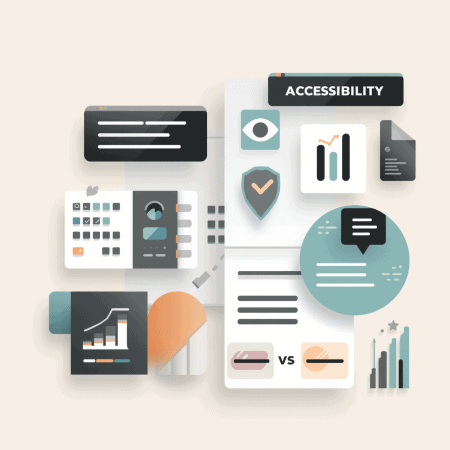
Manual BI dashboard accessibility remediation is often uneven, inconsistent, and slow. Without a standardized, platform-aware approach, accessibility fixes vary by developer, dashboard, and tool. 

When a compliance complaint, audit finding, or federal funding review arises, agencies are frequently forced into rapid remediation. That response often happens without the internal expertise needed to act confidently and efficiently. 

This gap quickly becomes more than a technical issue. It creates legal exposure, reputational damage, and remediation costs far greater than proactive investment. 

As state and federal accessibility mandates tighten, organizations without a clear remediation strategy face increasing audit findings, legal action, and public scrutiny. 

The Accessibility Skills Gap in BI and Analytics Teams 

Accessibility expertise inside BI tools is rare. Most analytics teams are staffed with dashboard builders and developers, but very few accessibility specialists. 

Teams may understand how to build dashboards that look clean and run fast, yet lack deep knowledge of how assistive technologies interpret visualizations, metadata, and interaction models. Without that expertise, even well-designed dashboards can fail accessibility reviews. 

Avaap’s Solution: BI Dashboard Accessibility Remediation Services 

Avaap’s BI dashboard accessibility remediation services pair platform-specific BI expertise with accessibility-aware dashboard engineering. 

Our consultants assess accessibility gaps, remediate non-text content, address structural and visual barriers, and align metadata, so dashboards read clearly to assistive technology. The result is dashboards that meet WCAG expectations and work for every constituent. 

Avaap works alongside stakeholders to define an actionable remediation approach. We can own delivery end-to-end or coach internal teams through remediation. Our engagement offers two reusable, long-term assets: 

  • An Accessibility Remediation Tracker 
  • A Reusable Accessibility Playbook 

These deliverables ensure accessibility improvements extend beyond a single project. 

Key Features of Avaap’s BI Accessibility Services

  • Accessibility Assessment and WCAG Gap Analysis: A WCAG-mapped review of dashboards and agency checklist responses is delivered as a prioritized Accessibility Remediation Tracker, giving teams a clear path forward. 

  • Cross-Platform Dashboard Remediation: Remediation for alt text, semantic structure, color and contrast, keyboard navigation, and input assistance across Tableau, Power BI, and other BI tools. 

  • Accessibility-Aware Data and Dashboard Engineering: Standardized field names, metadata, and calculated fields ensure alt text, tooltips, and semantics are readable and logical for assistive technologies. 

  • Reusable Accessibility Playbook and Templates: A WCAG-compliant template library and an accessibility playbook your team can apply to every future dashboard build. 

  • Advisory and Enablement: Working sessions focused on accessible design patterns, color standards, metadata discipline, and keyboard-first navigation for dashboard builders and reviewers. 

Measurable Outcomes for Public-Sector Analytics Teams 

  1. Lower Compliance Risk 

    WCAG 2.0 and 2.1 Level AA conformance reduces exposure to complaints, legal action, and audit findings. 
  1. Faster Path to Conformance 

    A platform-agnostic remediation approach compresses timelines, even across large dashboard estates. 
  1. Inclusive by Default Dashboards 

    Dashboards that work for all users, including those relying on assistive technology. 
  1. Standards That Scale 

    Playbooks and templates transform one remediation effort into a sustainable accessibility standard. 
  1. Platform Flexibility 

    Consistent delivery across Tableau, Power BI, and other BI platforms within your environment. 

Why Choose Avaap for BI Dashboard Accessibility Remediation 

Avaap’s Data, Analytics, and AI brings deep expertise across Tableau, Power BI, and modern BI platforms, with a strong track record supporting state and local government clients. 

We understand how public-sector data environments are built, governed, and audited, and how to make analytics accessible without disrupting operational workflows. 

With Avaap, accessibility moves beyond one-off compliance work. It becomes part of how the analytics function operates, ensuring public-facing dashboards remain compliant, usable, and inclusive over time. 

To learn more about Avaap’s BI dashboard accessibility remediation services, get in touch with our Data, Analytics, & AI team. 
Connect with us

Filed Under: Posts Tagged With: government, tableau

February 5, 2026 by Ben Bell

As the world gears up for Super Bowl LX, fans and analysts alike are obsessing over the matchup, setting the odds, and publicizing narratives. Behind the scenes, data is informing the story. With access to cutting-edge platforms, both professionals and enthusiasts are leveraging data to gain deeper insights into every aspect of the NFL. 

Microsoft aims to help customers uncover insights faster than ever through AI-enabled tools, making data discovery more intuitive than ever. Historically, organizations have struggled to balance time, cost, and scope, with business users pleading for IT support to produce data insights. The evolution of AI-enabled solutions removes the barriers by enabling natural-language prompts that support self-service analytics.

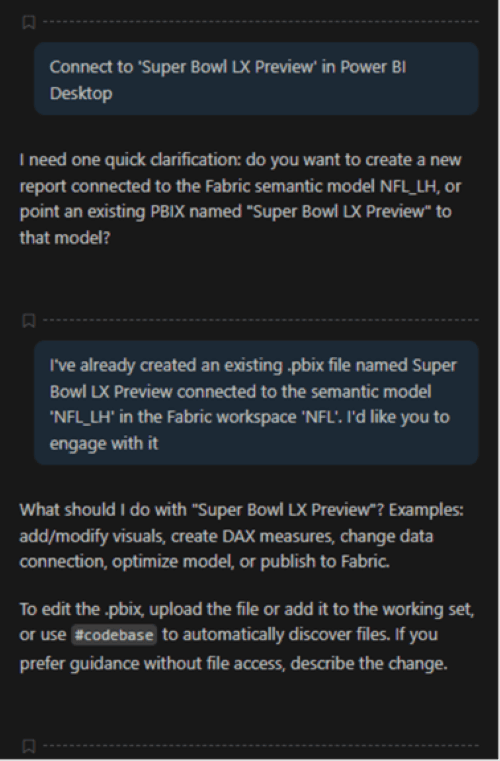
At Avaap, we’re constantly testing emerging capabilities to understand how they can accelerate outcomes for our clients. With Super Bowl season upon us, I explored NFL data using natural language through the Power BI Modeling MCP Server. 

Preparing NFL Data in Microsoft Fabric 

After ingesting NFL parquet files into my Microsoft Fabric workspace lakehouse, establishing semantic model relationships using a combination of system-generated keys and natural keys, I booted up Visual Studio Code, installed the GitHub copilot chat and Power BI Modeling MCP Server extensions to begin chatting with the data using natural language prompts through the Visual Studio Code interface. Having familiarity with the tools, getting started was easy and seamless. 

Working With AI on Real-World, Messy Data 

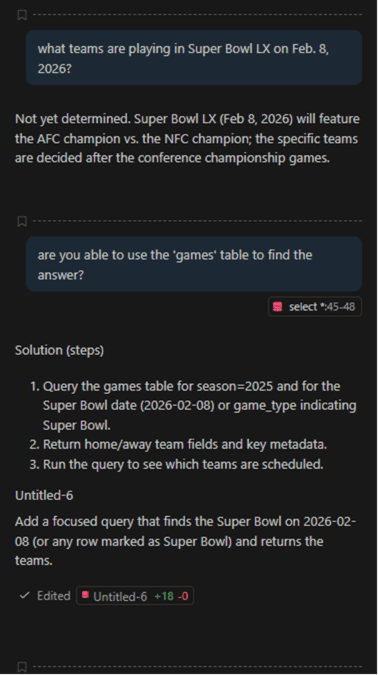
The AI chat assistant performs best with clear instructions and may ask clarifying questions before taking action. 

Screenshot of GitHub Copilot Chat discussing how to connect to the 'Super Bowl LX Preview' PBIX file and engage with the Power BI semantic model in Microsoft Fabric, with instructions for editing, creating visuals, and managing files.

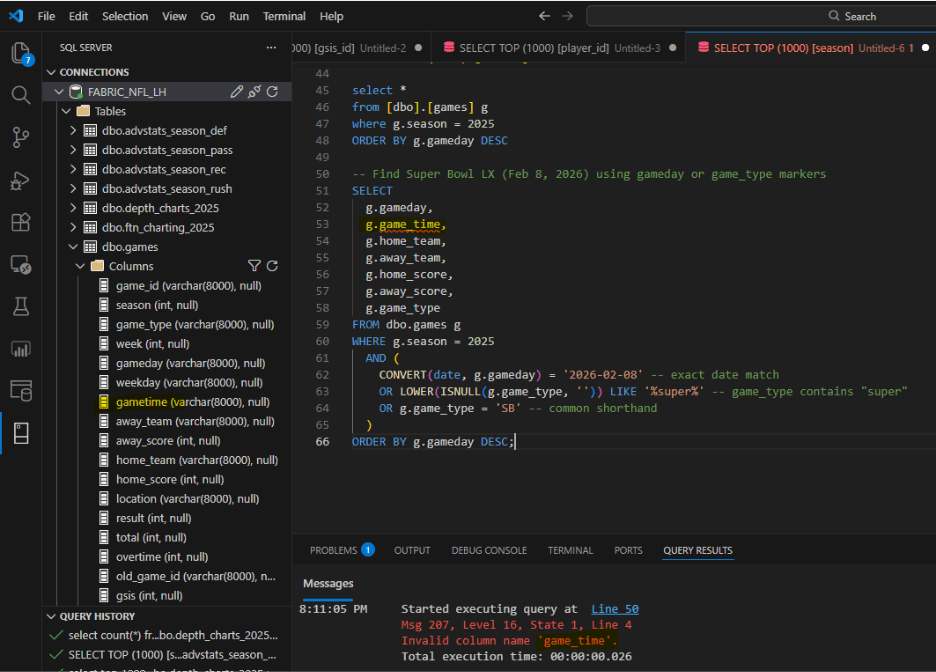
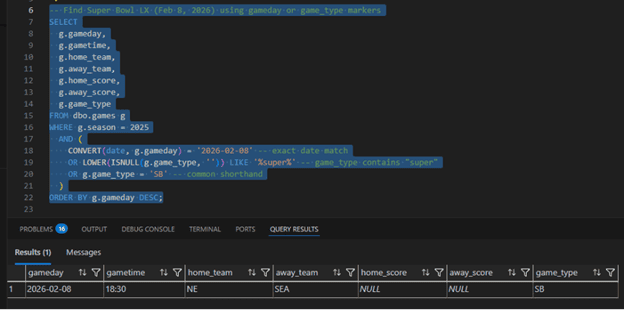
To start, I wanted to see if it could confirm the matchup for Super Bowl LX using the semantic model. Initially, it stumbled, but with more explicit direction and a manual correction to address a misspelled field name (“game_time” instead of “gametime”), the chat agent produced a SQL query against the semantic model that returned the desired insight.  

Screenshot of GitHub Copilot Chat explaining that Super Bowl LX teams are not yet determined, followed by a user prompt asking whether the ‘games’ table can be used, and step‑by‑step guidance on how to query the dataset.
Screenshot of a SQL query in Visual Studio Code using the Power BI Modeling MCP Server to identify the Super Bowl LX game, with returned results showing the date, gametime, teams, and game type.

For this experiment, I intentionally limited the level of transformation and curation of the data, recognizing that real-world datasets are often messy. I wanted to challenge AI to handle naming mismatches, data quality issues, and vague prompts.  

This experience highlighted how important human expertise is for working effectively with AI solutions. 

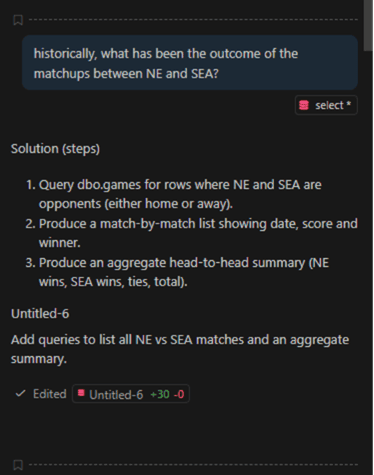
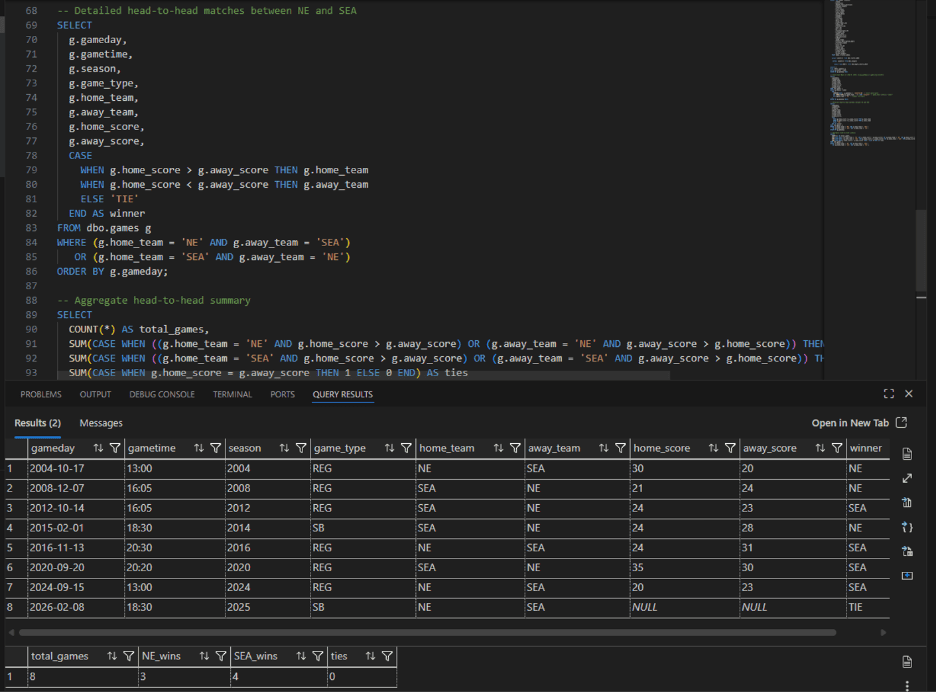
The next prompt went smoothly, even though it was a bit more complicated, showing how quickly the workflow can stabilize once the model understands the structure.

Screenshot of GitHub Copilot Chat responding to a prompt about historical matchups between NE and SEA, providing solution steps for querying game results and generating a head‑to‑head summary.

Exploring the Capabilities of Power BI MCP Servers 

The queries shown above only scratch the surface of what’s possible with MCP servers. It’s possible to explore agentic AI with direct, controlled access combing Power BI Modeling MCP server, the Power BI REST API connection, and sufficient Fabric tenant privileges. This allows an agent to create reporting programmatically through the direction of natural language prompts.

Because the Power BI MCP Server is still in preview, administrators should proceed cautiously.

How Competitors Are Advancing Conversational and AI‑Driven Analytics 

Microsoft’s competitors continue to invest heavily in similar AI-enabled solutions. Tableau has embedded generative and conversational AI across its platform (e.g., Tableau Agent and Tableau Pulse) to let users explore data with natural language, automatically surface insights, and proactively monitor key metrics within everyday workflows. Similarly, Alteryx has introduced Alteryx Copilot and other generative AI tools within its Alteryx One platform, giving analysts the ability to build and refine analytics workflows, automate repetitive tasks, and accelerate time‑to‑value through natural language interactions. 

These advancements in data, analytics, and AI will continue to boost self-service capabilities and improve the efficiency and effectiveness of data professionals.  

Strategy Is Fundamental to Unlocking AI Value 

While AI and analytics tools are rapidly evolving, their value depends on thoughtful investment. Costs can rise quickly if compute resources are wasted on poorly designed or inefficient data products. To ensure meaningful impact, organizations must pair technology adoption with strategic clarity.  

Data Strategy: 

  • How does data factor into the business strategy to deliver a competitive advantage? 
  • What’s the organizational construct for people to engage in advancing the mission leveraging data? 
  • How will process and technology empower people through this strategic vision? 

Data Management:

  • Who will own and maintain the data? 
  • How are terms and metrics defined? 
  • How is data quality ensured for critical data elements? 
  • How are data products exposed through a data catalog to support discoverability? 

Just as it’s hollow for a coach to simply tell players to score more, it’s equally ineffective for administrators or leaders to urge improvement without clear guidance.  

However, if IT delivers AI-enabled solutions that allow educators or social workers to identify students or residents who may benefit from support through natural language prompts, they gain a significant advantage in meeting needs effectively. 

AI Is Powerful, but Human Partnership Remains Essential 

Artificial intelligence continues to impress, but it’s still heavily dependent on human partnership. Organizations need Business Analysts to gather requirements, clarify objectives, and define expectations. Data stewards must take ownership of maintaining the data. A hybrid hub-and-spoke organizational construct for content ownership may become predominant, featuring a centralized data team managing the data platform, while embedded analysts work within specific business units.  

Data teams can better enable self-service analytics and improve the accuracy of natural language prompts by following best practices, adhering to uniform standards, and championing data governance by adhering to the business glossary. Ultimately, AI is powerful, but only as strong as the clarity and quality of the underlying data. 

Where AI and Modern Analytics Platforms Converge 

Experiments like this explore what’s possible when modern analytics platforms and AI copilots converge. Realizing these capabilities at scale requires more than tools, it demands clear strategy, disciplined data management, and alignment across people, process, and technology.  

That’s where Avaap excels. From data strategy and governance to modern analytics platform implementation and AI-enabled analytics, we help organizations turn innovation into measurable value. If you’re looking to harness the next generation of data, analytics, and AI, our team is ready to help.  

Connect with Us

Filed Under: Posts

brandmark

Stay Connected

Be the first to learn about new services and tools to help your organization thrive.

  • Our Services
  • Our Partners
  • Our Customers
  • Who We Are
  • What We Think
  • Careers & Culture
  • Resources
  • Events
  • News
  • Search

© 2026 Avaap | Privacy Policy | Site by Wonderly.

logo

1400 Goodale Blvd., Suite 100,
Columbus, OH 43212
(614) 796-0090

© 2026 Avaap | Privacy Policy | Site by Wonderly.