logo
Our Services

Equipped For Client Success

Avaap delivers expertise, personalized support, and results that advance our customers’ toughest challenges.

Explore All Services

Strategic Technology Solutions →

Workday Implementation Snowflake Implementation IT Strategy & Governance AI-Powered Business Solutions Post-Production Support

Data, Analytics, & AI →

Data & AI Strategy Data Platform Modernization AI-Powered Insights Data Visualization & Interaction Data Workload Migration & Conversion

Organization Transformation & People Solutions →

Organizational Change Management Avaap Change Academy™ Change Maturity Assessment Program & Project Enablement
  • Our Partners
    • Workday
    • Snowflake
    • Tableau
    • Alteryx
    • All Partners →
  • Our Customers
    • Higher Education
    • State & Local Government
    • Transit & Special Districts
    • All Industries →
  • Who We Are
    • About Avaap
    • Careers & Culture
  • What We Think
    • Thought Leadership
    • Webinars
    • View All →
Work With Us
Search
logo
  • Avaap
  • Our Services
    • Strategic Technology Solutions
      • Workday Implementation
      • Snowflake Implementation
      • IT Strategy & Governance
      • AI-Powered Business Solutions
      • Post-Production Support
      • All Strategic Technology Solutions
    • Data, Analytics, & AI
      • Data & AI Strategy
      • Data Platform Modernization
      • AI-Powered Insights
      • Data Visualization & Interaction
      • Data Workload Migration & Conversion
      • All Data, Analytics, & AI
    • Organization Transformation & People Solutions
      • Organizational Change Management
      • Avaap Change Academy™
      • Change Maturity Assessment
      • Program & Project Enablement
      • All Organization Transformation & People Solutions
    • All Services
  • Our Partners
    • Workday
    • Alteryx
    • Tableau
    • Snowflake
    • All Partners
  • Our Customers
    • Higher Education
    • State & Local Government
    • Transit & Special Districts
    • All Customers
  • Who We Are
    • About Avaap
    • Careers & Culture
  • What We Think
    • Thought Leadership
    • Webinars
    • View All
Explore All Services
Work With Us
Menu

March 18, 2026 by Alyssa Mehrberg

Unstructured data, including PDFs, documents, emails, images, and audio, now account for 80-90% of enterprise information. Most legacy data platforms were not designed to analyze this data at scale, leaving organizations unable to fully leverage the information they already have. 

For the first time, AI can summarize, classify, translate, and reason over unstructured data directly, unlocking new possibilities for faster, more informed decision‑making. For state and local government and education (SLED) organizations, this shift is especially impactful. It enables better services, improved compliance, and more efficient operations. 

Snowflake’s AI Data Cloud enables organizations to activate all their data, and Avaap is helping public sector and education teams turn AI potential into real business outcomes. 

Snowflake AI Data Cloud: The Modern Data Platform for Government and Education 

Snowflake brings structured, semi‑structured, and unstructured data together in a single, secure, cloud‑native platform. With native LLM support, multi‑cloud flexibility, and built‑in governance, Snowflake delivers: 

  • Centralized data across formats 
  • Secure, in‑platform AI execution 
  • Scalable performance without infrastructure management 

Unlike traditional systems, Snowflake is built to keep pace with rapid AI innovation without introducing complexity or risk. 

Why AI Thrives on Snowflake for Government and Education 

Many organizations experiment with AI through disconnected tools such as chatbots, document parsers, or custom scripts. Each comes with its own UI, security model, and integration challenges. The result is fragmented solutions that are difficult to scale or govern. 

Snowflake takes a different approach by unifying: 

  • Data 
  • Governance 
  • Security 
  • AI capabilities 

This unified platform approach enables faster delivery, consistent monitoring, and the flexibility to adopt new AI models as the ecosystem evolves without rewriting applications. 

Snowflake’s momentum in AI innovation reflects this strategy. For example, Snowflake recently announced a multi‑year partnership with OpenAI, reinforcing its commitment to providing enterprise‑grade, vendor‑flexible AI capabilities inside the Snowflake platform. Combined with native support for leading LLM providers, organizations gain the freedom to choose the right model for each use case while maintaining security and control. 

The result is AI projects that move from months to days, with fewer handoffs and lower implementation risk. 

Key Snowflake AI Capabilities to Know 

  • Cortex AI Functions 
    Built‑in, managed functions for summarization, translation, classification, and document extraction. These functions are ideal for high‑volume unstructured data scenarios, such as processing thousands of PDFs, emails, or case notes using just a few lines of SQL. 
  • Snowflake Intelligence 
    A secure, conversational interface that allows users to ask questions in natural language and receive answers grounded in their own structured and unstructured data. No SQL or dashboards are required. 
  • AI Agents 
    AI‑powered agents that automate repetitive, manual tasks like searching across PDFs, running recurring reports, or pulling insights from multiple systems. This helps teams save time and reduce errors. 
  • Cortex Search and Cortex Analyst 
    Cortex Search enables vector and keyword search for RAG and chatbot applications. Cortex Analyst provides natural‑language answers from structured data. Together, they power intelligent applications that surface the right insights at the right time. 
  • Cortex Code 
    Cortex Code enables developers and data teams to build and extend AI‑powered applications directly in Snowflake using familiar languages like Python. This supports custom logic, orchestration, and advanced AI workflows without leaving the platform. 

Snowflake AI Use Cases for SLED Organizations 

Avaap is helping SLED organizations move from experimentation to impact with Snowflake AI. Real‑world outcomes include: 

  • 30–50% reduction in manual review time by summarizing and translating counseling notes to improve student support 
  • Earlier identification of at‑risk students using sentiment analysis to surface warning signals before issues escalate 
  • Faster insight from call center audio, enabling teams to detect trends, sentiment, and service gaps at scale 
  • Improved policy access and compliance by transforming static documents into searchable, AI‑driven knowledge 

These quick wins demonstrate how AI can meaningfully improve daily operations, not just future roadmaps. 

Start Your Snowflake AI Journey with Avaap 

AI adoption does not have to be overwhelming. With Snowflake’s unified Data + AI platform and Avaap’s deep SLED expertise, organizations can modernize confidently and deliver results that matter. 

Download the whitepaper to explore detailed use cases, architecture guidance, and practical next steps for adopting Snowflake AI. 

Download Insights

Filed Under: Posts

February 23, 2026 by Ginger Ruiz

The bi-annual Workday update (2026R1) is almost here — and whether it’s your first Workday release or your tenth, staying ahead of key dates and preparing your tenants can feel overwhelming. Avaap’s Workday AMS team is here to help you navigate the 2026R1 release with confidence. 

Below is an outline to the Workday 2026 Release 1 timeline, milestones, and post‑release checklist so your organization is prepared, compliant, and ready to take advantage of every new feature. For personalized support, contact your Avaap AMS Engagement Manager anytime. 

Workday 2026R1 Release Dates: Key Deadlines to Know 

Understanding the timeline is the first step in planning your release activities. 

  • 2026R1 Feature Release Documentation: January 28, 2026 
  • 2026R1 Preview Refresh / Release: February 7, 2026 
  • Release Preparation Window: February 7 – March 14, 2026 
  • Production Release: March 14, 2026 

Mark these dates on your calendar to ensure your team stays aligned throughout the release cycle. 

How to Prepare for Workday 2026R1: Key Pre‑Release Activities 

  1. February 7 – March 14, 2026 

During the preparation window, your team should: 

  • Run task audits prior to and following release tenant updates 
  • Test the 2026R1 feature release in Preview 
  • Review the What’s New report and Release Notes 
  • Monitor for any delivery date changes 
  • Communicate with Workday to resolve questions or issues 
  • Plan organizational change management activities 
  • (Optional) Lock your Production tenant prior to release 

These actions ensure you identify potential impacts early and prepare your teams for new functionality. 

2. Go-Live Day: March 14, 2026 

Once your Production tenant is updated: 

  • Review any delayed features 
  • Configure released features 
  • (Optional) Unlock your Production tenant 
  • Begin adopting new features and functionality 
  • Revisit Release Notes for updates to fixes, enhancements, and retirements 

This is the ideal time to ensure your configuration stays optimized and aligned with Workday’s new capabilities. 

Workday 2026 Release 1 Checklist: Post‑Production Activities 

After Workday updates your Production tenant (starting March 14, 2026), complete the following: 

1. Unlock User Accounts 

If you locked accounts during the update: 

  • Use Manage User Accounts → Unlock user accounts 

2. Activate Workday Account Sessions 

If user sessions were terminated: 

  • Go to Manage Workday Maintenance Window → Activate sessions 

3. Re‑Enter Configuration Adjustments 

Reapply any configuration changes made to your Sandbox Preview tenant. 

4. Rerun Audits 

  • Run audits completed in earlier checklists 
  • Resolve all audit issues 

 5. Review Retirement Notes 

  • Track new feature retirements and upcoming deprecations 
  • Document required follow-up actions 

 6. Review Fix & Feature Notes Weekly 

  • Filter by your functional areas 
  • Subscribe to notes relevant to your organization 

Staying current ensures you’re aware of changes impacting HCM, Finance, Payroll, Reporting, Integrations, and more. 

Why Partner with Avaap’s Workday AMS Team? 

A Workday release is more than a system update — it’s an opportunity to optimize your configuration, enhance user experience, and adopt features that drive efficiency. 

Avaap’s Workday AMS team helps you: 

  • Evaluate impacts specific to your tenants 
  • Plan and execute comprehensive testing 
  • Support change management and communication 
  • Maximize the value of your Workday investment 

If you’re looking for post-production support or a more efficient release process, we’re here to help. 

If you’re preparing for Workday’s 2026R1 update, don’t miss our upcoming webinar where Avaap’s experts break down the most impactful changes across HCM, Financials, and Student. In just 90 minutes, you’ll gain practical guidance on configuration updates, testing priorities, and the real‑world implications that go beyond what’s included in the standard release notes.

Get the insights your team needs to approach the 2026R1 release with confidence.

Register Now

Filed Under: Posts

February 17, 2026 by Alyssa Mehrberg

Public-sector agencies and higher‑education institutions are facing rapidly growing data demands, rising governance expectations, and a constant need to do more with fewer technical resources. These realities make modern data platforms essential — but technology alone doesn’t solve the deeper challenges of complexity, fragmentation, and inconsistent data use. 

Avaap’s new whitepaper examines why scalable Snowflake architecture is the key to building a reliable, governed, and future‑ready data foundation. Below is a brief preview of the core concepts explored inside. 

The Need for Scalable Data Architecture 

Higher‑education institutions and local government agencies manage diverse datasets — from student lifecycle records to public safety, HR, finance, tax, health, and learning systems. At the same time, they serve independent stakeholders with different goals, operate under strict compliance requirements, and often lack large technical teams. 

A scalable data architecture helps organizations: 

  • Prevent fragmentation as more departments adopt Snowflake 
  • Maintain consistent definitions across the institution 
  • Ensure transparency and auditability 
  • Streamline governance in environments where data sensitivity is non‑negotiable

Without a strong architectural foundation, even powerful platforms become difficult to manage and costly to scale. 

A Layered Snowflake Architecture Designed to Grow 

A practical, layered approach to Snowflake provides structure, clarity, and adaptability. This approach is built around a three‑zone design: 

  • Raw Zone for immutable, auditable data 
  • Curated Zone for standardized, business‑aligned datasets 
  • Business Zone for consumption‑ready data products 

This separation allows institutions to evolve their analytics programs without reworking ingestion pipelines or disrupting upstream data. When new reporting or regulatory requirements emerge, teams adjust the curated or business layers — not the entire environment. 

Workload Isolation for Predictable Performance 

Large, multi-department Snowflake environments require clear boundaries for compute. Workload isolation ensures that ingestion pipelines, transformations, analytics workloads, AI/ML exploration, and ad‑hoc queries remain independent and predictable. 

With dedicated warehouses for each workload type, organizations gain: 

  • Stable performance during peak periods 
  • Protection for mission‑critical operations 
  • Cleaner cost management and right‑sizing of compute 

This is one of the most important architectural principles for environments that need reliability and budget predictability. 

Governance and Observability Built into the Architecture 

In both education and government, data governance is not optional. Sensitive data — student records, taxpayer information, health-related data, HR systems — demands strict control and clear ownership. 

Embedding governance from day one includes: 

  • Role‑based access and least‑privilege models 
  • Masking for sensitive columns and rows 
  • Object tagging for classification and lineage 
  • Built‑in data quality checks 
  • Usage monitoring for accountability 

These practices allow institutions to scale confidently while maintaining trust and compliance. 

Get the Full Snowflake Architecture Whitepaper 

This preview highlights only a small portion of the architectural recommendations inside Avaap’s full whitepaper. To explore the detailed blueprints, performance strategies, governance models, and real‑world lessons for public‑sector and higher‑education institutions, download the complete guide. 

Download the full whitepaper to access every insight. 

Download Now

Filed Under: Posts

February 12, 2026 by Josh Kuhlman

Organizational transformation is like a relationship. It starts with excitement, faces challenges, and requires commitment to thrive. Like any great partnership, successful change depends on two things: chemistry—the alignment between people and processes—and commitment—the ability to sustain engagement over time. Without these, even the best‑laid plans can falter. 

As organizations navigate organizational transformation and change management, these two elements often determine whether transformation succeeds or stalls. 

The Chemistry of Change: Aligning People and Processes in Organizational Transformation 

Compatibility matters. Your organizational culture is the heartbeat of change, influencing how decisions are made and how employees respond to new ways of working. Introducing new processes without considering cultural dynamics is like forcing two people into a relationship without shared values—it rarely works. 

Signs of a Mismatch Between Culture and Change: 

  • Employees cling to old ways despite new tools or workflows. 
  • Communication feels transactional rather than inspiring. 
  • Leaders struggle to model behaviors aligned with the change. 

How Avaap Can Play Matchmaker in Organizational Transformation 

As an organizational transformation consulting partner, Avaap helps organizations build the right foundation for change: 

  • Assess Before You Commit: We start with cultural and readiness assessments to understand behaviors, values, and potential resistance points. 
  • Tailored Engagement: Our communication and training strategies resonate with your unique culture, using authentic language and examples. 
  • Governance as Relationship Counseling: Governance models ensure alignment between leadership and teams, reducing disconnects and creating shared accountability. 
  • Empower Change Champions: Influencers advocate for new processes and bridge cultural gaps across the organization. 

Once There’s a Perfect Match, Commitment Issues Can Appear in Transformation 

Big transformations aren’t a quick fling. They’re a long‑term relationship that require sustained effort. Over time, even the most motivated teams can experience change fatigue, especially without reinforcement and clarity. 

Why Commitment Wavers During Transformation: 

  • Unclear Vision: If the future state isn’t compelling, people lose interest. 
  • Lack of Reinforcement: Without visible wins, engagement drops. 
  • Change Overload: Too much change at once leads to burnout. 

Avaap’s Approach to Sustaining Commitment and Engagement During Change 

Avaap’s organizational change management approach focuses on keeping momentum strong throughout the transformation journey: 

  • North Star Alignment: We anchor every initiative to a clear, inspiring vision. 
  • Celebrate Milestones: Recognizing progress keeps energy high. 
  • Continuous Communication: Frequent, transparent updates maintain trust. 
  • Change Champions: Influencers keep momentum alive and model desired behaviors. 
  • Pulse Checks: Regular feedback loops allow us to adjust strategies before fatigue sets in. 

Practical Change Management Tips for Leaders: 

  • Frame new processes as enhancements, not replacements. 
  • Share success stories that highlight the impact on employees and customers. 
  • Break large initiatives into manageable phases. 
  • Celebrate early wins to reinforce compatibility and commitment. 

Closing Thought: Keeping the Spark Alive in Organizational Transformation 

When people and processes click—and commitment stays strong—organizational transformation feels far more achievable. Avaap helps organizations find that perfect match by aligning culture with the future state, sustaining engagement, and guiding teams through every step of change. 

Ready to build chemistry and commitment for your organizational transformation? Explore Avaap’s Organizational Change Management services. 

Let’s make your change story a success. 

Connect with Us

Filed Under: Posts

February 5, 2026 by Ben Bell

As the world gears up for Super Bowl LX, fans and analysts alike are obsessing over the matchup, setting the odds, and publicizing narratives. Behind the scenes, data is informing the story. With access to cutting-edge platforms, both professionals and enthusiasts are leveraging data to gain deeper insights into every aspect of the NFL. 

Microsoft aims to help customers uncover insights faster than ever through AI-enabled tools, making data discovery more intuitive than ever. Historically, organizations have struggled to balance time, cost, and scope, with business users pleading for IT support to produce data insights. The evolution of AI-enabled solutions removes the barriers by enabling natural-language prompts that support self-service analytics.

At Avaap, we’re constantly testing emerging capabilities to understand how they can accelerate outcomes for our clients. With Super Bowl season upon us, I explored NFL data using natural language through the Power BI Modeling MCP Server. 

Preparing NFL Data in Microsoft Fabric 

After ingesting NFL parquet files into my Microsoft Fabric workspace lakehouse, establishing semantic model relationships using a combination of system-generated keys and natural keys, I booted up Visual Studio Code, installed the GitHub copilot chat and Power BI Modeling MCP Server extensions to begin chatting with the data using natural language prompts through the Visual Studio Code interface. Having familiarity with the tools, getting started was easy and seamless. 

Working With AI on Real-World, Messy Data 

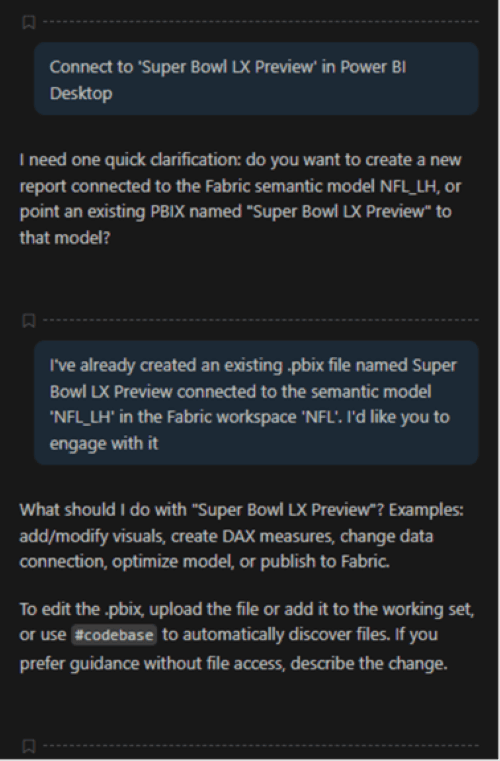
The AI chat assistant performs best with clear instructions and may ask clarifying questions before taking action. 

Screenshot of GitHub Copilot Chat discussing how to connect to the 'Super Bowl LX Preview' PBIX file and engage with the Power BI semantic model in Microsoft Fabric, with instructions for editing, creating visuals, and managing files.

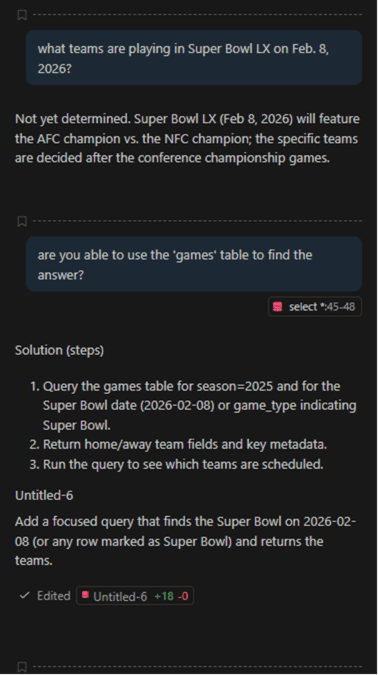
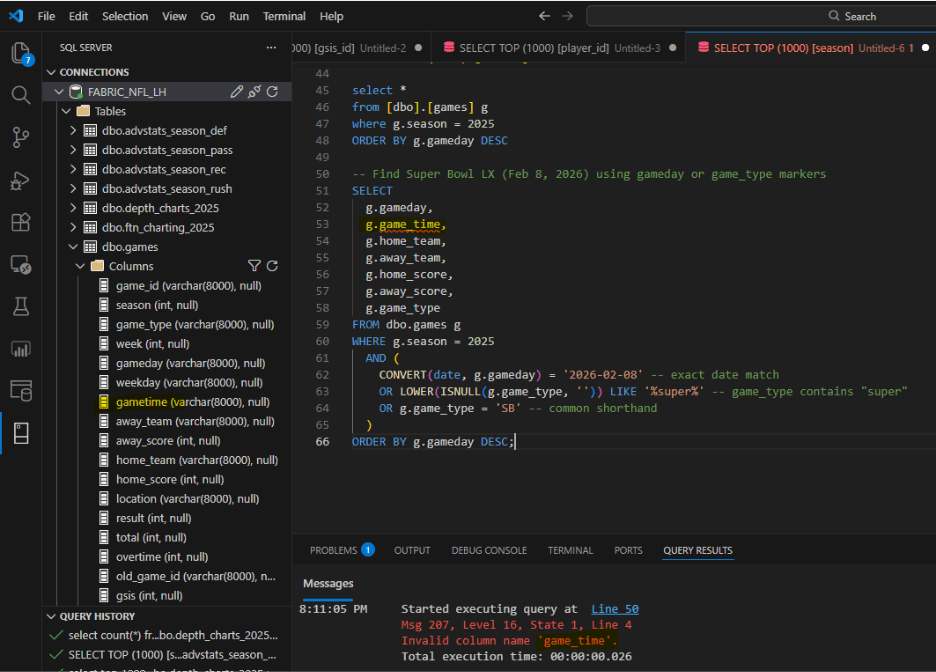
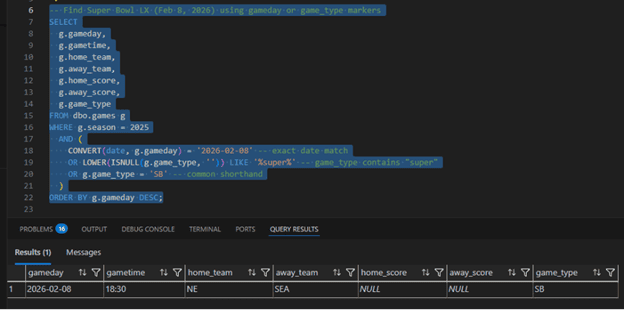
To start, I wanted to see if it could confirm the matchup for Super Bowl LX using the semantic model. Initially, it stumbled, but with more explicit direction and a manual correction to address a misspelled field name (“game_time” instead of “gametime”), the chat agent produced a SQL query against the semantic model that returned the desired insight.  

Screenshot of GitHub Copilot Chat explaining that Super Bowl LX teams are not yet determined, followed by a user prompt asking whether the ‘games’ table can be used, and step‑by‑step guidance on how to query the dataset.
Screenshot of a SQL query in Visual Studio Code using the Power BI Modeling MCP Server to identify the Super Bowl LX game, with returned results showing the date, gametime, teams, and game type.

For this experiment, I intentionally limited the level of transformation and curation of the data, recognizing that real-world datasets are often messy. I wanted to challenge AI to handle naming mismatches, data quality issues, and vague prompts.  

This experience highlighted how important human expertise is for working effectively with AI solutions. 

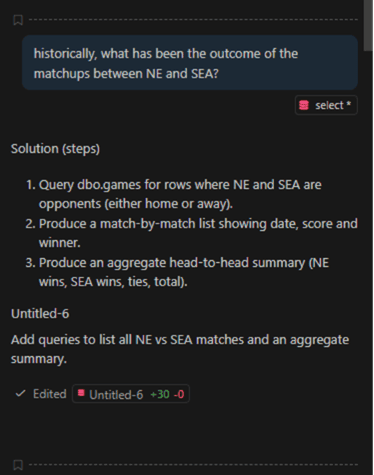
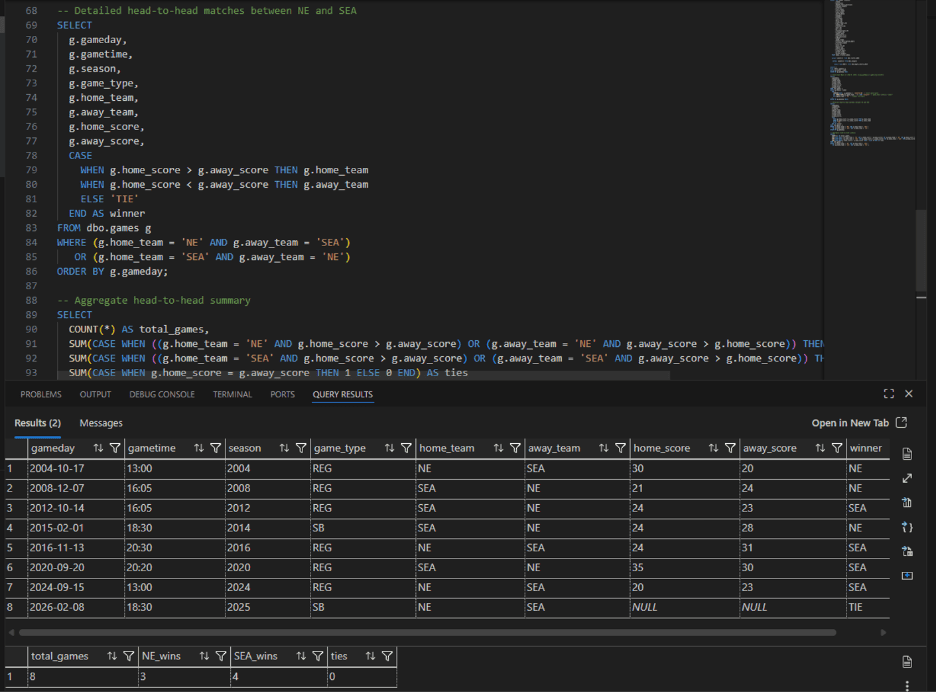
The next prompt went smoothly, even though it was a bit more complicated, showing how quickly the workflow can stabilize once the model understands the structure.

Screenshot of GitHub Copilot Chat responding to a prompt about historical matchups between NE and SEA, providing solution steps for querying game results and generating a head‑to‑head summary.

Exploring the Capabilities of Power BI MCP Servers 

The queries shown above only scratch the surface of what’s possible with MCP servers. It’s possible to explore agentic AI with direct, controlled access combing Power BI Modeling MCP server, the Power BI REST API connection, and sufficient Fabric tenant privileges. This allows an agent to create reporting programmatically through the direction of natural language prompts.

Because the Power BI MCP Server is still in preview, administrators should proceed cautiously.

How Competitors Are Advancing Conversational and AI‑Driven Analytics 

Microsoft’s competitors continue to invest heavily in similar AI-enabled solutions. Tableau has embedded generative and conversational AI across its platform (e.g., Tableau Agent and Tableau Pulse) to let users explore data with natural language, automatically surface insights, and proactively monitor key metrics within everyday workflows. Similarly, Alteryx has introduced Alteryx Copilot and other generative AI tools within its Alteryx One platform, giving analysts the ability to build and refine analytics workflows, automate repetitive tasks, and accelerate time‑to‑value through natural language interactions. 

These advancements in data, analytics, and AI will continue to boost self-service capabilities and improve the efficiency and effectiveness of data professionals.  

Strategy Is Fundamental to Unlocking AI Value 

While AI and analytics tools are rapidly evolving, their value depends on thoughtful investment. Costs can rise quickly if compute resources are wasted on poorly designed or inefficient data products. To ensure meaningful impact, organizations must pair technology adoption with strategic clarity.  

Data Strategy: 

  • How does data factor into the business strategy to deliver a competitive advantage? 
  • What’s the organizational construct for people to engage in advancing the mission leveraging data? 
  • How will process and technology empower people through this strategic vision? 

Data Management:

  • Who will own and maintain the data? 
  • How are terms and metrics defined? 
  • How is data quality ensured for critical data elements? 
  • How are data products exposed through a data catalog to support discoverability? 

Just as it’s hollow for a coach to simply tell players to score more, it’s equally ineffective for administrators or leaders to urge improvement without clear guidance.  

However, if IT delivers AI-enabled solutions that allow educators or social workers to identify students or residents who may benefit from support through natural language prompts, they gain a significant advantage in meeting needs effectively. 

AI Is Powerful, but Human Partnership Remains Essential 

Artificial intelligence continues to impress, but it’s still heavily dependent on human partnership. Organizations need Business Analysts to gather requirements, clarify objectives, and define expectations. Data stewards must take ownership of maintaining the data. A hybrid hub-and-spoke organizational construct for content ownership may become predominant, featuring a centralized data team managing the data platform, while embedded analysts work within specific business units.  

Data teams can better enable self-service analytics and improve the accuracy of natural language prompts by following best practices, adhering to uniform standards, and championing data governance by adhering to the business glossary. Ultimately, AI is powerful, but only as strong as the clarity and quality of the underlying data. 

Where AI and Modern Analytics Platforms Converge 

Experiments like this explore what’s possible when modern analytics platforms and AI copilots converge. Realizing these capabilities at scale requires more than tools, it demands clear strategy, disciplined data management, and alignment across people, process, and technology.  

That’s where Avaap excels. From data strategy and governance to modern analytics platform implementation and AI-enabled analytics, we help organizations turn innovation into measurable value. If you’re looking to harness the next generation of data, analytics, and AI, our team is ready to help.  

Connect with Us

Filed Under: Posts

January 30, 2026 by Abby Yoakum

How a Process Analysis Quick Assessment Lays the Foundation for Smarter, More Efficient Workday Experiences 

Organizations today are under constant pressure to operate faster, smarter, and more efficiently. Many organizations are turning to Workday AI agents, Workday’s latest generation of intelligent automation tools designed to streamline work across HR, Finance, Procurement, and beyond. These agents promise to automate routine tasks, enhance decision-making, and improve organizational productivity. 

But here’s the challenge: AI can only be as effective as the processes it supports.

When your organization has a clear view of how processes operate today—and where opportunities exist to streamline and improve—it’s much easier to unlock the full value of Workday’s AI capabilities. Our Process Analysis (PA) Quick Assessment (QA) is designed to create that clarity, helping teams quickly understand current workflows and identify practical improvements that set the stage for smarter, AI-enabled outcomes.

What Is the Process Analysis Quick Assessment? 

The Process Analysis Quick Assessment is a focused, structured analysis designed to help Workday customers gain a deep understanding of their current business processes within a specific function—such as hiring, recruiting, or item procurement—and uncover opportunities to streamline, simplify, and optimize them. 

This assessment becomes the launchpad for Workday automation and AI-enabled processes, aligning directly with how Workday’s Business Process Framework (BPF) governs approvals, routing, and workflow logic inside the platform.

How Process Analysis Prepares Your Organization for Workday AI

Workday AI agents enable organizations to work faster, smarter, and with greater confidence across HR and Finance. By leveraging these agents, teams can simplify complex work, reduce manual effort, and focus more time on higher-value decisions—while continuously improving how work gets done. 

With Workday AI Agents, your organization can: 

  • Accelerate recruiting by sourcing and screening candidates more efficiently. 
  • Speed up financial close by streamlining reconciliation and exception handling. 
  • Strengthen procurement operations by managing supplier contracts and approvals with greater consistency. 
  • Empower employees with real-time answers and automated task support in their flow of work. 

To get the most value from AI Agents, organizations need a strong foundation of clear, standardized, and well-documented processes supported by reliable data. When processes are streamlined and intentional, AI can be applied consistently and at scale—setting teams up for meaningful, repeatable results. 

A Process Analysis Quick Assessment bridges that gap by ensuring your organization’s processes are optimized and ready for AI. 

The Process Analysis Quick Assessment: A Five-Step Approach 

Our Quick Assessment follows a proven five-step framework designed to bring clarity, alignment, and actionable outcomes: 

  1. Inventory & Scope 
    We work with department leaders to catalog all processes within a function and identify up to eight to analyze in depth. 
    Benefit: Establishes which workflows are most critical and most suitable for automation or AI support. 
  1. Current State 
    We meet with Subject Matter Experts (SMEs) to document existing processes through detailed process maps and narratives. 
    Benefit: Defines the structure, decision points, and data flows that AI agents will rely on. 
  1. Confirmation 
    We review the process documentation with SMEs to validate accuracy. 
    Benefit: Ensures a trusted foundation for future automation, ensuring there are no assumptions and no surprises. 
  1. Future State 
    We analyze inefficiencies, redundancies, and risks, then design a simplified, future-ready version of the process. 
    Benefit: Creates a clean, optimized process where AI agents can perform consistently and reliably. 
  1. Final Report 
    We deliver an actionable roadmap of improvement initiatives tailored to your organization’s goals. 
    Benefit: Prioritizes which processes are ready for AI enablement — and which need improvement first. 

How the Quick Assessment Accelerates Workday AI Agent Adoption  

When organizations design processes that are clean, consistent, and measurable from the start, Workday’s Agent System of Record becomes a powerful way to track AI activity, apply governance, and ensure value at scale. The Process Analysis Quick Assessment enables this by: 

  • Clarifying Process Complexity – identifying hidden manual steps, redundant approvals, and inconsistent data sources that limit automation. 
  • Improving Data Quality – mapping where process data originates and ensuring it’s accurate, complete, and AI-ready. 
  • Defining Decision Logic – documenting clear business rules and roles so AI agents can act confidently and transparently. 
  • Establishing Governance – helping teams define ownership and accountability for both human and AI-driven steps. 
  • Creating a Transformation Roadmap – delivering a sequence of initiatives to streamline processes and prepare for AI agent integration. 

 In short, this assessment not only makes your processes more efficient—it makes them Workday AI-compatible. 

Real-World Example: From Process Insight Into Workday AI Impact 

Imagine a company struggling with manual steps and long turnaround times in its recruiting process. The Process Analysis Quick Assessment reveals multiple redundant approvals, unclear candidate ownership, and inconsistent data capture.

By redesigning and simplifying this workflow, the company creates a standardized foundation where a Workday Recruiting Agent can now automatically screen applicants, schedule interviews, and send follow-up communications.

The result? Faster hiring cycles, better candidate experiences, and a recruiting team that can focus on talent strategy instead of manual coordination.

Build a Future‑Ready Workday Environment with Better Processes

Workday’s vision is clear: move organizations from systems of record to systems of action, where data, automation, and intelligence work together seamlessly. But to get there, organizations must first understand and optimize their processes. 

The Process Analysis Quick Assessment is your key to doing just that. By providing deep process insight and a clear improvement roadmap, it sets the stage for meaningful automation and ensures your Workday AI agents can perform to their fullest potential. 

Ready to Unlock the Full Power of Workday AI?

Contact us to kick off a Process Analysis Quick Assessment and give your organization the clarity, confidence, and process foundation it needs to thrive in the AI-driven future of Workday. 

Get Started

Filed Under: Posts

January 26, 2026 by Tim Oberschlake

Implementing Workday is a big achievement—but what happens after go-live? Many organizations assume the work is over once the system is live, but the continuous optimization of Workday is where significantly more value can be achieved for your organization over the months and years to come. Keeping Workday optimized, compliant, and aligned with your business goals over time can only be achieved by taking advantage of Workday’s semi-annual releases and extensive functionality that may not have been fully implemented in your initial implementation. Without a clear governance structure, your ERP system can quickly become inefficient and harder to manage. 

That’s where post-go-live governance comes in. It’s the key to making sure your Workday investment continues to deliver value for years to come. 

What Is Workday Post Go-Live Governance? 

Post go-live governance is the structured approach to managing Workday after deployment. It involves defining why governance matters, establishing how it works, and creating clear roles, decision-making guidelines, and support processes. This ensures your ERP investment continues to deliver value and adapt to business changes. 

Why is Post Go-Live Governance Critical for Workday? 

Investing in governance helps organizations avoid inefficiencies and compliance risks. A strong governance structure provides: 

  • Operational Efficiency: Streamlined processes and accountability 
  • Compliance Protection: Reduces gaps and prevents risky workarounds 
  • Cross-Functional Collaboration: Supports an ERP environment with multiple touchpoints 
  • Continuous Optimization: Enables policy updates and process improvements 

Top Benefits of Workday Governance After Go-Live

  • Alignment with organizational culture 
  • Clear decision-making and change management 
  • Improved efficiency through defined roles 
  • Reduced compliance and security risks 
  • Sustainable system health and adaptability 

Key Activities and Stages of Workday Post Go-Live Governance

Building a strong governance framework involves several critical steps. At Avaap, we guide organizations through these stages: 

  1. Define the Why: Understand the purpose and value of post go-live governance for Workday. 
  1. Define the How: Establish the approach, processes, and structure for governance. 
  1. Structure and People: Identify roles, responsibilities, and decision-making authority. 
  1. Support Processes: Implement workflows and protocols for ongoing system support. 
  1. Decision Making: Create clear guidelines for evaluating and approving changes. 

Why Choose Avaap for Workday Post Go-Live Governance? 

  • Deep Workday Expertise: Extensive experience with ERP systems 
  • Proven Governance Framework: Built from hundreds of successful implementations 
  • Strategic Alignment: Practical guidance to connect governance with enterprise goals 

What You’ll Gain from Avaap’s Workday Post Go-Live Governance Services: 

  • A documented governance structure tailored to your organization 
  • Defined decision-making and support processes 
  • A resource plan for ongoing support 
  • A roadmap for sustainable Workday management 

Ready to Optimize Your Workday Investment? 

Don’t let your Workday system lose momentum after go-live. Connect with Avaap’s change management team to build a governance framework that drives efficiency, compliance, and long-term success. 

Connect with Us

Filed Under: Posts

January 13, 2026 by Ginger Ruiz Leave a Comment

In 2023, Workday announced a major shift: moving from private cloud to public cloud. This transition offers significant benefits—faster time to value, improved performance and security, and expanded functionality for future enhancements. However, migration is mandatory for organizations still on Workday’s private cloud. Two years later, many Avaap clients are just beginning this journey.

If your organization is preparing for Workday Public Cloud Migration (PCM), here’s what you need to know.

What Is Workday Public Cloud Migration?

Workday’s PCM initiative requires all customers to move from private to public cloud hosting. This isn’t just a technical update; it’s a tenant migration, meaning your production tenant will be replaced with a new one in the public cloud.

Beyond being a requirement, there are several benefits to moving to a public cloud:

  • Faster time to value
  • Enhanced security and performance
  • Expanded functionality for future updates

How Do You Know If You’re on Public Cloud?

Check your Workday URL:

  • Private Cloud: WD5 or WD10 (one or two digits)
  • Public Cloud: Three digits in the URL

What’s Changing During Migration?

  • Your Workday URL will change (assigned by Workday)
  • Studio integrations may be impacted
  • Single sign-on and authentication updates
  • IP address changes

Avaap uses specialized tools to identify impacted integrations and help you plan accordingly.

How Avaap Can Help

Migrating to Workday’s public cloud is complex and requires more than technical updates—it demands strategic planning, organizational change management, and expert coordination.

1. End-to-End Migration Support

Avaap provides a programmatic approach to ensure success:

  • Preparation: Confirm migration date, review PCM documentation, sign agreements, and assess impact.
  • Project Planning: Allocate resources, identify key events, and align stakeholders.
  • Execution & Support: Kick off the project, create test and cutover plans, make technical changes, and validate integrations.
  • Deployment & Transition: Ensure a smooth go-live and provide production support.

2. Organizational Change Management

There are many organizational change management considerations when transitioning to the public cloud, and Avaap helps your team navigate them with a proven framework:

  • Assess & Align: Understand current state and readiness.
  • Plan & Activate: Build a scalable change plan.
  • Measure & Sustain: Keep progress aligned with future goals.

3. Additional Support

  • Vendor Coordination: Seamless collaboration for successful execution.
  • Tools & Templates: Accelerate migration and minimize disruption.

Ready to Learn More?

Watch our full webinar to learn more about the upcoming migration and how Avaap can help.

Watch Webinar

Filed Under: Posts

January 12, 2026 by Jason Wood Leave a Comment

In today’s data-driven world, organizations need more than fragmented insights—they need a complete, connected view of their data to make smarter, faster decisions. That’s where Avaap’s Panoramic AI, powered by Alteryx, comes in. 

Panoramic AI consolidates data from multiple sources into a single, comprehensive platform, providing a 360-degree view of engagement and outcomes. Whether you serve citizens, students, or customers, Panoramic AI helps you transform raw information into actionable insights that drive impact. 

Key Benefits of Avaap’s Panoramic AI 

Organizations often struggle with siloed systems and inconsistent data. Panoramic AI solves that challenge by delivering: 

  • Fuel AI with Trusted Data 
    Provide accurate, comprehensive data for better insights and predictions. 
  • One-Stop Solution 
    Access advanced analytics and AI with continuously refreshed data from multiple systems. 
  • Cross-System Linkage 
    Connect disparate datasets—even without common keys—for unified analysis and AI with a single query. 
  • Rapid Insights 
    Quickly answer critical questions and gain strategic insights to improve decision-making and service delivery. 

Core Capabilities of Panoramic AI

Panoramic AI is designed for ease of use, featuring an intuitive, low-code/no-code interface that enables even non-technical users to participate in solution development and analysis. 

1. Data Management

  • Collect and consolidate disparate data 
  • Profile and cleanse data 
  • Blend and link data from multiple sources 
  • Transform and curate datasets 
  • Build 360-degree longitudinal data marts (e.g., student, citizen, employee, customer, provider) 

2. Analytics & AI: 

  • Feature engineering for predictive models with solution accelerators 
  • Predictive variable association analysis to identify strong predictors 
  • Accelerated predictive/AI model development 
  • Data visualization and reporting integrated with your preferred tools 

Why Avaap Partners with Alteryx for Data Integration 

Avaap partners with Alteryx to simplify data collection, cleansing, linkage, analytics, and AI at scale. Benefits include: 

  • Reduced complexity 
  • Faster delivery 
  • Enhanced collaboration 
  • Increased transparency and data literacy 
  • Flexibility and scalability 
  • Automation for efficiency 

Who Can Benefit from Panoramic AI? 

Panoramic AI is built for government, higher education, and non-public sector organizations: 

1. Government (Citizen/Employee/Vendor/Provider 360): 

  • Detecting fraud, waste, and abuse 
  • Increasing cross-program enrollment 
  • Improving program effectiveness 
  • Enhance employee satisfaction and retention 

2. Higher Education (Student/Employee 360): 

  • Optimizing enrollment strategies 
  • Improving student success and retention 
  • Boosting alumni engagement and donations 
  • Enhancing employee satisfaction and retention 

Ready to Elevate Your Data Strategy? 

Data is one of your organization’s most valuable assets—but only if you can harness it effectively. Avaap’s Panoramic AI, powered by Alteryx, helps you break down silos, unify information, and turn insights into impact. Whether you’re improving citizen services, driving student success, or enhancing customer experiences, Panoramic AI enables faster, smarter decisions with intuitive tools that empower collaboration across your team. 

If you’re ready to elevate your data strategy and deliver measurable outcomes, Avaap is here to help.  

Connect with Us

Filed Under: Posts Tagged With: alteryx, analytics, data, data and analytics

January 5, 2026 by Steve Csuka Leave a Comment

With the start of 2026, organizations are prioritizing their digital transformation roadmap to stay competitive and agile. One theme continues to dominate boardroom conversations: digital transformation. The pace of change isn’t slowing down, and the organizations that thrive will be those that embrace innovation, modernize their systems, and align technology with strategic goals. 

Why You Should Start Your 2026 Digital Transformation Roadmap Now 

The beginning of a new year is the perfect time to evaluate your technology landscape. Legacy systems may have served you well, but they often limit agility, scalability, and the ability to deliver exceptional experiences for employees and customers. A well-planned digital transformation roadmap ensures your organization can operate more efficiently, make data-driven decisions, and adapt quickly to market changes. 

Key Steps to Build a Successful 2026 Digital Transformation Roadmap 

1. Align Technology with Business Strategy 

  • Define your organization’s top business priorities for 2026. 
  • Ensure every technology initiative directly supports these goals. 
  • Treat digital transformation as a business enabler, not just a system upgrade. 

2. Assess Current Systems and Gaps 

  • Conduct a comprehensive audit of your technology stack. 
  • Identify bottlenecks, inefficiencies, and manual processes prone to error. 
  • Use findings to prioritize investments and eliminate redundancies. 

3. Focus on Data & Analytics

  • Establish strong data governance policies for accuracy, security, and compliance. 
  • Integrate data across silos to create a single source of truth. 
  • Invest in advanced analytics and AI to empower smarter, faster decision-making. 
  • Data is the foundation of transformation. Ensure your roadmap includes strategies for data governance, integration, and advanced analytics to empower better decision-making. 

4. Plan for Change Management 

  • Develop a change management strategy that emphasizes communication and transparency. 
  • Provide training programs to upskill employees on new tools. 
  • Engage stakeholders early to build buy-in and adoption. 

5. Leverage Cloud and Automation 

  • Modernize infrastructure with cloud solutions for scalability and flexibility. 
  • Deploy automation tools to reduce costs and free resources for innovation. 
  • Explore AI-driven workflow tools for customer service and supply chain 

Looking Ahead: Making Your 2026 Digital Transformation Roadmap Actionable 

Digital transformation is not a one-time project—it’s an ongoing journey. By starting now and building a clear roadmap, you position your organization for success in 2026 and beyond. Avaap is here to help you navigate this journey with expertise, proven methodologies, and a commitment to delivering measurable outcomes. 

Ready to start your transformation?  

Connect with our team to learn how Avaap can help you design and execute a roadmap that drives real business value. 

Connect with Us

Filed Under: Posts Tagged With: change management, data and analytics, digital transformation

  • « Previous Page
  • 1
  • 2
  • 3
  • 4
  • …
  • 42
  • Next Page »
brandmark

Stay Connected

Be the first to learn about new services and tools to help your organization thrive.

  • Our Services
  • Our Partners
  • Our Customers
  • Who We Are
  • What We Think
  • Careers & Culture
  • Resources
  • Events
  • News
  • Search

© 2026 Avaap | Privacy Policy | Site by Wonderly.

logo

1400 Goodale Blvd., Suite 100,
Columbus, OH 43212
(614) 796-0090

© 2026 Avaap | Privacy Policy | Site by Wonderly.